Esta página solo está disponible en inglés. Ir a la portada en español

×

Diese Seite ist nur auf Englisch verfügbar. Zur deutschen Startseite

×

Cette page est disponible uniquement en anglais. Aller à la page d'accueil en français

×

Thermo King deploys telematics across DTI fleet in the US

DTI expects $1.1 million in fuel and maintenance savings over 12 months after cutting continuous-mode engine runtime from 6% to 2%.

Thermo King deploys telematics across DTI fleet in the US

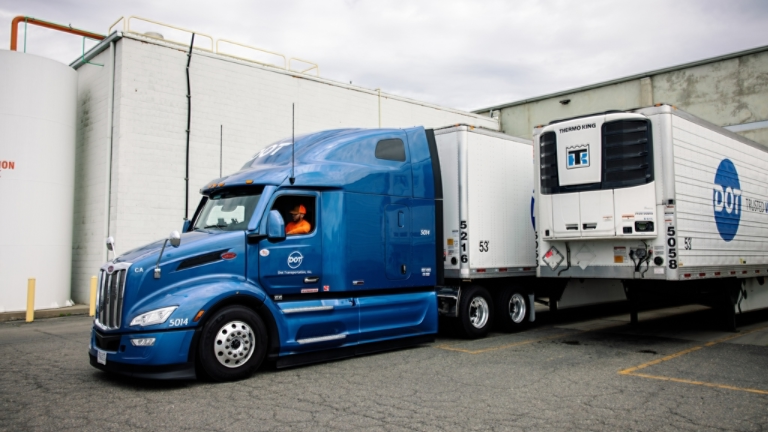
Thermo King said it partnered with Dot Transportation, Inc. (DTI) to implement TracKing Pro telematics across DTI’s refrigerated trailer fleet in the US. The companies said the rollout is aimed at improving fleet efficiency, reducing engine runtime, managing maintenance costs and helping prevent load loss.

DTI operates more than 2,900 trailers from 13 distribution centers across the US and has used Thermo King transport refrigeration units for more than three decades, according to the company. Thermo King said DTI began using TracKing Pro telematics after the solution was launched in 2023 to turn trailer data into actionable fleet insights.

Thermo King said TracKing Pro is part of its ConnectedSuite fleet telematics portfolio and includes algorithms to estimate fuel consumption, electricity usage and opportunities to improve uptime. The system also includes a benchmark analytics dashboard that allows customers to compare fleet energy use and operations against best-in-class fleets.

According to the company, DTI used telematics data to monitor its Thermo King Precedent multi-temperature units and identify savings from operating in CYCLE-SENTRY rather than continuous mode. Thermo King said DTI reduced engine runtime associated with continuous mode from 6% to 2%, a change expected to save $1.1 million in fuel and maintenance costs over 12 months.

The company also said proactive monitoring helped prevent a $78,000 load loss after a trailer refrigeration unit was inadvertently turned off and restarted through a two-way remote command. Over a 12-month period, DTI increased its TracKing Pro subscriptions from 600 to more than 2,300.

“The value of a reliable connected solution and proactive monitoring that TracKing Pro telematics offers has yielded proven savings for our organization,” said John Ourth, Director of Planning, Dot Transportation, Inc. “It is a service that allows us to operate more efficiently, protects our valuable loads and ensures the food we haul arrives safely to the communities we serve.”

Get the daily refrigeration briefing

One email a day. Trusted by 3,000+ RACHP professionals.

More on Cold Chain

All on Cold Chain →

Insights

Secop's Solar Direct Drive (SDD) System Earns WHO PQS Approval – The Team Behind It
Article

Secop’s Solar Direct Drive (SDD) System Earns WHO PQS Approval – The Team Behind It

Partner's material In March 2026, Secop’s Solar Direct Drive Power Management Module was granted WHO PQS prequalification and officially listed in the WHO Catalogue of Prequalified Immunization Devices. The WHO IMD-PQS (Immunization Devices Performance, Quality and Safety programme) is the global benchmark for cold chain equipment used in immunisation. Being listed in its catalogue is

22 Jun 2026
Case Study - Effect of Louvers or diffusers on air flow distribution and cooling time on a meat log during Chill cycle
Tech Guide

Case Study – Effect of Louvers or diffusers on air flow distribution and cooling time on a meat log during Chill cycle

By Kushal Aurangabadkar An experimental analysis was conducted on a cooler space measuring 3.66 m × 6.096 m (12.0 ft × 20.0 ft), equipped with an ammonia refrigeration coil, five 30 cm (12 in.) fans, and five diffusers. The study measured airflow patterns, cooling rates, and heat transfer efficiency in meat storage by testing two configurations:

Kushal Aurangabadkar · 21 Jan 2026
Total Cost of Ownership (TCO) for Modular Refrigeration Systems in Life Sciences Distribution Centers
Tech Guide

Total Cost of Ownership (TCO) for Modular Refrigeration Systems in Life Sciences Distribution Centers

by Ramez Naguib, P.E. Introduction Life sciences distribution centers are under immense pressure to deliver consistent temperature control, comply with increasingly stringent regulations, and optimize operational efficiency. Traditional built-up refrigeration systems often prove cumbersome, costly, and slow to implement. In contrast, modular, factory-assembled refrigeration systems have emerged as a compelling alternative. Drawing on lessons from

14 Jan 2026
Everything on Cold Chain: 2,041 articles, 1 case study, 23 insights

Most read this month

All news →